Credits
Client: BMW Germany
Agency: Territory DE
Production Studio: The Invisible Realm
Director: Felipe Posada
CGI World Creation, Motion Design & Direction: Felipe Posada
Performance: 3M+ plays, 200K+ Instagram likes
Agency: Territory DE
Production Studio: The Invisible Realm
Director: Felipe Posada
CGI World Creation, Motion Design & Direction: Felipe Posada
Performance: 3M+ plays, 200K+ Instagram likes
Overview
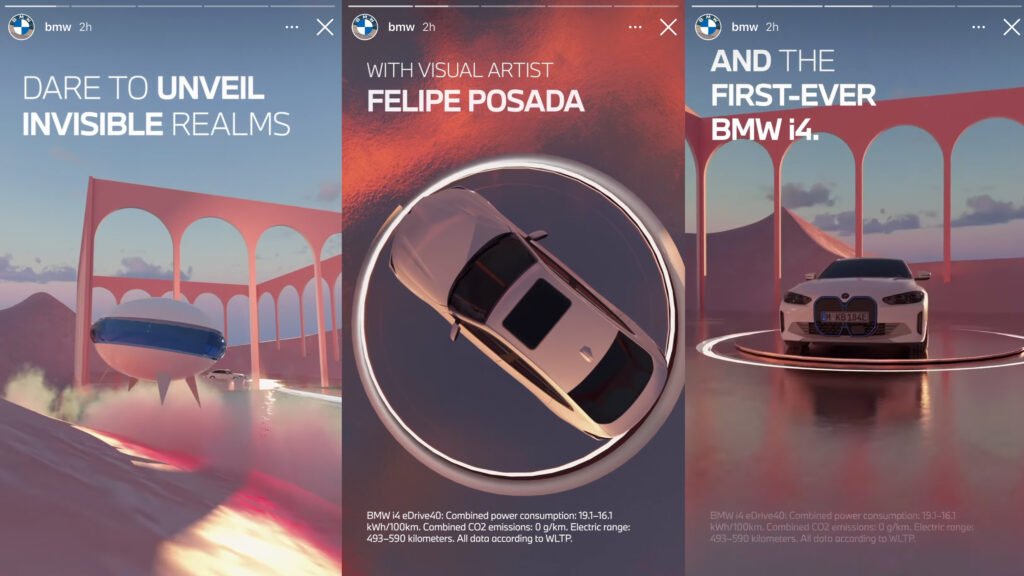
Partnered directly with BMW Germany to create the social launch for the First-Ever BMW i4. BMW commissioned The Invisible Realm specifically for its distinctive approach to synthetic world-building—environments that balance surreal aesthetic vision with physical coherence. The project required designing and executing a complete synthetic world where artistic intent and technical accuracy inform each other, delivering both creative differentiation and production quality at commercial timeline.
The Integration Challenge
BMW's brief granted complete creative freedom: envision how their flagship electric vehicle exists within The Invisible Realm's visual universe. Success required:
- Establishing distinctive color systems, material palettes, and spatial atmospheres
- Maintaining physical plausibility in lighting behavior, material properties, and architectural logic
- Integrating product seamlessly into an imagined environment
- Delivering commercial production quality on launch timeline
This demanded integrated capability: artistic vision defining what the world should be, technical systems mastery building it at production scale.
Approach
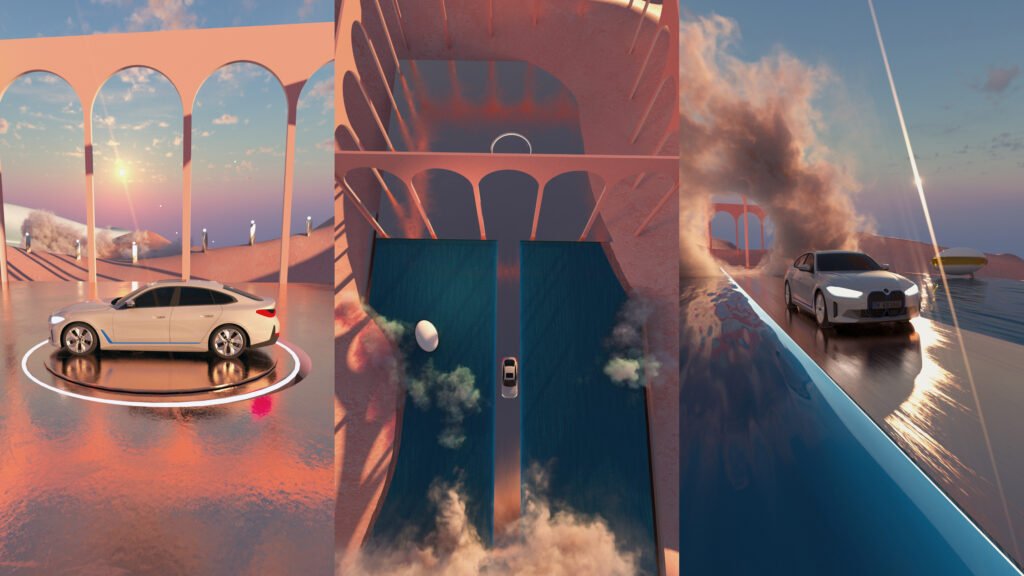
World Design: Developed the environment's visual language: Color relationships, atmospheric qualities, spatial logic, material treatments: establishing rules for how this world behaves while maintaining The Invisible Realm's aesthetic signature.
Technical Architecture: Built the environment using Cinema 4D with Octane renderer, implementing:
- VDB volumetric systems for atmospheric effects
- Water dynamics with accurate reflection and refraction
- Physically-based lighting calibrated for specific mood and color qualities
- Material systems balancing artistic intent with technical consistency
- Modular spatial architecture enabling compositional flexibility
- The artistic framework determined design intent. The technical systems delivered execution at production quality.
Production Systems Infrastructure:
- Procedural environment generation enabling rapid iteration
- GPU rendering pipeline optimized for commercial timeline
- Quality validation across technical accuracy and aesthetic coherence
- Cross-functional workflow integrating creative vision with production constraints
Technical Components: Physics simulation, material design, spatial architecture, rendering optimization: all calibrated to serve both visual distinctiveness and physical plausibility.
Results
The spot delivered 3M+ views across BMW social channels with 200K+ Instagram likes. BMW credited The Invisible Realm alongside their brand across all launch communications, positioning the artistic practice as integral to their product narrative.
More significantly: demonstrated that enterprise clients seek authentic creative vision when it elevates their product beyond standard execution. Major brands don't always demand creative compromise—sometimes distinctive world-building capability is exactly what commercial objectives require.
Implications for Synthetic Environment Generation
Commercial production of synthetic worlds reveals constraints that research environments often miss. Environments succeed when they integrate artistic coherence with technical accuracy—one without the other produces results that fail perceptual validation despite meeting technical specifications.
Production-scale world generation requires both systematic architecture and creative judgment. Technical frameworks generate variations; artistic curation ensures those variations maintain coherence. Quality assessment needs evaluation of physical accuracy and perceptual plausibility.
The BMW project demonstrates this integration at commercial delivery standard. Scaling this capability requires architecting systems that preserve both technical rigor and creative integrity—generating diverse environments that feel genuinely plausible because they honor how humans actually perceive synthetic worlds.
Technical Specifications
Production Environment: Cinema 4D, Octane Renderer, Adobe After Effects
Core Systems: VDB simulation, physically-based materials, GPU rendering, procedural generation
Domain Integration: Physics simulation, lighting systems, spatial design, production pipeline architecture
Delivery: Commercial production timeline, enterprise quality standards
Core Systems: VDB simulation, physically-based materials, GPU rendering, procedural generation
Domain Integration: Physics simulation, lighting systems, spatial design, production pipeline architecture
Delivery: Commercial production timeline, enterprise quality standards
Crafted 100% digital using Maxon Cinema 4D w/ Otoy Octane render and Adobe After Effects, the spot ran on all of BMW and BMWi social media channels amassing over 3M plays and receiving over 200K likes in Instagram Only.Â
" The most rewarding aspect of this project was seeing such an iconic brand supporting my art by incorporating The Invisible Realm as part of their visual narrative durintg the launch and highlighting it in all of its channels. It was a fully paid commercial project but that gesture alone made the project worth more than all the Ξ$€₿ in the world. " BMW has a honorable reputation for supporting artists which they have done throughout the decades. I feel incredibly humbled to have joined that saga - Felipe Posada.